

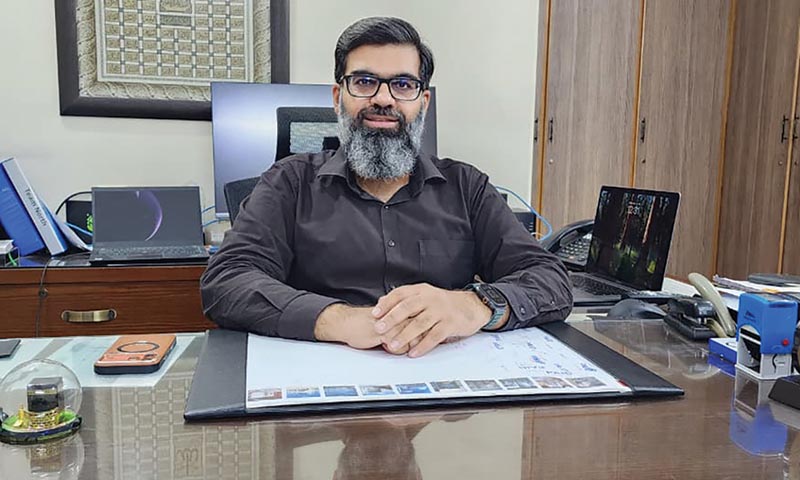
S.A. Hamid & Co. is combining industrial automation, cloud-based IIoT and machine learning to help Pakistani manufacturers operate with greater efficiency, visibility and resilience
Engineering Post interview with Engr. Jamal Nasir, CEO, S.A. Hamid & Co.
For more than six decades, S.A. Hamid & Co. has served Pakistan’s industrial sector with electrical control, automation and engineering solutions. Today, the Lahore-based company is extending that legacy into connected manufacturing—where plant data, cloud platforms and artificial intelligence support faster and more informed decisions.
Established in 1964, S.A. Hamid & Co. has grown into one of Pakistan’s longstanding providers of industrial automation, electrical control and engineering solutions. The company supplies internationally recognized industrial products and has delivered solutions to more than 400 clients across sectors including pharmaceuticals, textiles, food and beverages, paper, manufacturing and government installations.
Speaking to Engineering Post, Engr. Jamal Nasir said the company has been actively delivering industrial automation solutions since 2005. These projects range from individual machine automation to broader production-process improvements designed to raise efficiency, consistency and reliability.
“Automation is no longer optional for a modern industrial operation,” Mr. Jamal said. “When repetitive processes are controlled more accurately and dependence on manual intervention is reduced, manufacturers can achieve more consistent quality, stronger productivity and better use of their resources.”
Over the years, S.A. Hamid & Co. has worked across a wide industrial base, including pharmaceutical manufacturers, textile mills, classified government sectors and major organizations such as Unilever, United Detergents, Pepsi-Cola and Packages Paper Mills. Jamal said the company’s focus is not simply to supply equipment, but to deliver complete solutions that create measurable operational value.
That approach led the company towards the Industrial Internet of Things (IIoT). In 2018, according to Jamal, S.A. Hamid & Co. developed a cloud-based IoT platform capable of connecting with a wide variety of industrial machines. The platform allows management and engineering teams to monitor operating data remotely, assess machine performance and identify trends that may otherwise remain hidden in day-to-day production.
The practical value of this visibility extends beyond monitoring. Real-time and historical data can help an industrial organization evaluate whether a machinery upgrade is producing the expected return on investment. It can also support maintenance planning, capacity decisions and future capital expenditure with evidence rather than assumptions.
Managing the utilities that shape industrial cost
Mr. Jamal described five critical industrial utilities through the acronym WAGES: Water, Air, Gas, Electricity and Steam. Each can materially affect production cost, yet losses are often difficult to detect without continuous measurement.
Digital monitoring makes consumption visible across shifts, machines and production areas. This can help reveal wastage, leakage, abnormal use or possible theft, while enabling managers to compare resource consumption with actual output.
The same data also supports environmental performance. As international buyers place greater emphasis on carbon reporting and responsible production, manufacturers increasingly need reliable evidence of how energy and other resources are being used.
“We do not compete on price alone. We compete by creating greater value for every rupee our customers invest.”
This value-based philosophy, Nasir said, guides the company’s commercial and technical decisions. Rather than treating automation as a collection of isolated products, S.A. Hamid & Co. aims to connect equipment, engineering expertise and operational data into solutions that improve the customer’s business outcome.
The company is now expanding further into artificial-intelligence-based industrial applications. Its data engineering team has developed machine-learning models intended for industrial automation environments, with a focus on reducing unplanned downtime, lowering maintenance cost and improving plant reliability.
For Jamal, the direction is clear: industrial competitiveness will increasingly depend on the ability to measure, understand and act on operational data. Companies that combine sound engineering with connected systems and intelligent analysis will be better positioned to control costs, improve sustainability and respond to changing market expectations.