

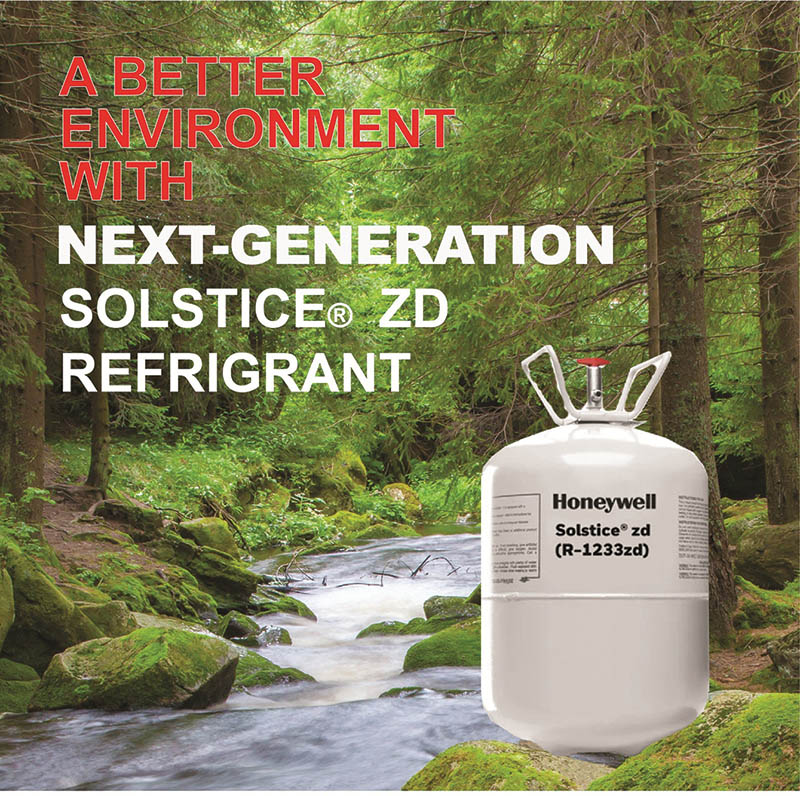
As industries worldwide work towards reducing carbon emissions and improving energy efficiency, the refrigeration and HVAC sectors are undergoing a significant transformation. The adoption of environmentally friendly refrigerants has become a key strategy in achieving sustainability goals while complying with increasingly stringent environmental regulations. Among the latest innovations, next-generation refrigerants such as R-1233zd have emerged as effective alternatives to conventional high Global Warming Potential (GWP) refrigerants.
Traditional refrigerants, including R-123 and R-245fa, have been widely used in industrial cooling and heating applications for decades. However, their relatively high GWP has raised environmental concerns, encouraging manufacturers and end users to adopt low-impact alternatives. R-1233zd is a fourth-generation hydrofluoroolefin (HFO) refrigerant designed to address these challenges by offering an ultra-low GWP of approximately 1, zero ozone depletion potential, and non-flammable characteristics. These properties make it a sustainable choice for industries seeking to reduce their environmental footprint without compromising system performance.
One of the major advantages of R-1233zd is its application in low-pressure centrifugal chillers used for cooling large commercial buildings, hospitals, airports, universities, and industrial facilities. Compared with traditional refrigerants, it delivers comparable energy efficiency while providing improved cooling capacity in many operating conditions. Higher system efficiency translates into lower electricity consumption, helping organizations reduce both operating costs and greenhouse gas emissions over the equipment’s lifecycle.
Beyond comfort cooling, R-1233zd has found growing applications in high-temperature industrial heat pumps, where waste heat can be recovered and reused for manufacturing processes. This improves overall energy utilization and supports industries in their transition toward low-carbon operations. The refrigerant is also widely used in Organic Rankine Cycle (ORC) systems, where low-grade waste heat or renewable energy sources are converted into useful electrical power. By improving heat recovery efficiency, industries can maximize energy resources that would otherwise be lost.
Another important application is in foam manufacturing, where R-1233zd serves as an environmentally responsible blowing agent for insulation products. Improved insulation performance contributes to lower energy consumption in buildings and industrial facilities, further supporting sustainability objectives across multiple sectors.
The adoption of environmentally friendly refrigerants also helps companies comply with evolving international regulations aimed at reducing greenhouse gas emissions and phasing down high-GWP refrigerants. Selecting refrigerants with minimal environmental impact not only supports regulatory compliance but also strengthens corporate sustainability initiatives and demonstrates a commitment to responsible environmental stewardship.
As industrial facilities continue to prioritize energy efficiency and carbon reduction, next-generation refrigerants such as R-1233zd are expected to play an increasingly important role in modern cooling and heating systems. Their combination of low environmental impact, operational safety, and high performance enables organizations to achieve both economic and environmental benefits. Investing in sustainable refrigerant technologies represents a practical step toward building more efficient, resilient, and environmentally responsible industrial operations for the future.