
Report by Engineering Post
Pakistan’s Blue Economy leverages its strategic maritime assets, including a 1046 kilometers coastline along the Arabian Sea and a 290000 square kilometer Exclusive Economic Zone (EEZ) , to foster sustainable economic growth.
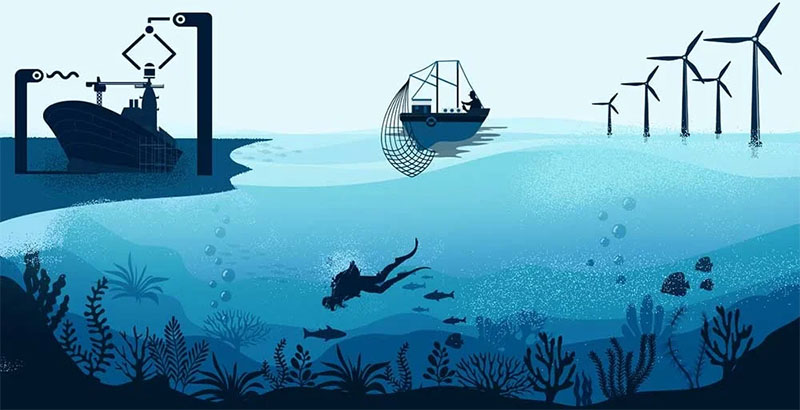
Encompassing maritime transport, fisheries, coastal tourism, ship recycling, and emerging sectors like renewable energy and desalination. The Blue Economy is pivotal for job creation, food security, and regional trade integration. Positioned at the crossroads of global trade routes, Pakistan’s ports Karachi, Port Qasim , and Gwadar serve as gateways to South Asia, the Middle East, and Central Asia, amplified by the China-Pakistan Economic Corridor (CPEC), which duly enhances connectivity through Gwadar’s deep-water port .
The global Blue Economy’s valuation exceeds US $ 1.5 trillion annually, with the potential to reach US $ 3 trillion by 2030. The sectorial strategy aligned with the National Economic Transformation Plan (URAAN Pakistan), and Sustainable Development Goals (SDGs) aims to capture a significant share, targeting a US $ 100 billion contribution by 2047. This strategy is supported by the institutional reforms, such as the Blue Economy Project Management Unit (OMU) which coordinates cross-sectoral policies, and the planned Blue Economy Coordination Centre in Gwadar, a hub for research and investment .
Stakeholder collaboration is central, involving the provincial governments i.e. Sindh and Balochistan, private partners e.g. AD Ports, COSCO, and international organizations e.g., IMO, FAO. Sindh’s focus on Karachi and Port Qasim aligns with trade – driven Annual Development Programme (ADP) priorities, while Balochistan’s Gwadar development supports CPEC’s regional vision. Challenges include environmental degradation ( e.g. 10% annual mangrove loss), overfishing (30% fish stock depletion), and infrastructure deficits, necessitating green technologies and regulatory harmonization.
Draft National Maritime Policy and Fisheries Policy as such aim to address these challenges, fostering sustainable and global competitiveness.