
Insights from Engr. Aftab Hanif, CEO, MEP Consulting Engineers (Pvt.) Ltd.
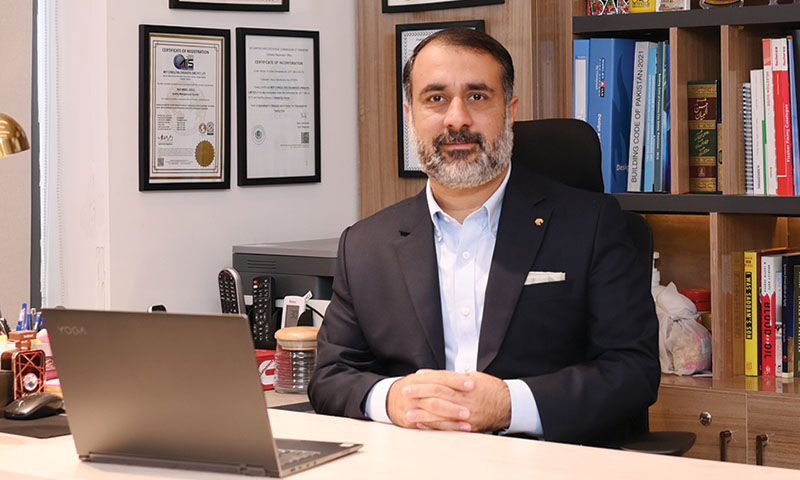
With over two decades of hands-on experience across some of Pakistan’s most complex and high-profile projects, Aftab Hanif, Chief Executive Officer of MEP Consulting Engineers (Pvt.) Ltd., stands among the leading names shaping the country’s modern built environment. In an exclusive conversation with Engineering Post, he shares his professional journey, the evolution of the MEP consultancy sector, the challenges facing Pakistan’s engineering ecosystem, and his vision for young engineers entering the profession.
A graduate of Electrical Engineering from UET Taxila, Aftab Hanif’s career began in the corporate telecom sector when he joined Mobilink as his first professional assignment. However, it was his move to NESPAK in 2008 that proved to be a defining chapter. He served there until December 2023, gaining extensive exposure to large-scale public and private sector projects, multidisciplinary coordination, and complex MEP systems. Reflecting on this period, he describes it as foundational to his professional growth. “NESPAK gave me the platform to understand how large infrastructure and high-rise projects actually function, from concept to execution,” he says.
After nearly 15 years with NESPAK, Aftab Hanif decided to take a bold step by establishing MEP Consulting Engineers (Pvt.) Ltd. The idea was not only to create a technically sound consultancy but also to contribute to the profession in a broader sense. “The vision behind forming MEP Consulting Engineers (Pvt.) Ltd was very clear, to provide quality engineering solutions and, equally important, to create meaningful job opportunities for young engineers,” he explains. According to him, Pakistan produces a large number of engineering graduates every year, but the lack of structured professional platforms limits their growth. “We wanted to build an organization where young engineers can learn, contribute, and grow professionally.”
Today, MEP Consulting Engineers (Pvt.) Ltd. offers comprehensive services across electrical, mechanical, HVACR, fire and life safety systems, along with infrastructure development. The firm has carved a niche for itself, particularly in high-rise buildings, where integrated MEP design and coordination are critical. Aftab Hanif notes that his company has successfully delivered projects in both the public and private sectors, including several classified assignments. “High-rise buildings demand precision, coordination, and deep technical understanding. Any mismatch between electrical, mechanical, or fire systems can cause serious delays and cost overruns,” he remarks.
Discussing early milestones, he recalls his first major independent project with pride. “My first project was New City Arcade, where we handled the complete MEP design and supervision for a mall spanning around eight hundred thousand square feet,” he shares. This was followed by the Mall of Sargodha, covering approximately eight hundred thousand square feet, and Zeta 1, where the firm provided electrical design and supervision. These projects, he says, helped establish the firm’s credibility in the competitive consultancy market.
One of the company’s strongest areas of expertise is fire and life safety, which is being strictly implemented now especially in Islamabad region. “We are the market leader in fire and life safety,” he states confidently. Over the years, MEP Consulting Engineers (Pvt.) Ltd has provided fire and life safety services to almost all existing high-rise buildings in Islamabad. The portfolio includes landmark structures such as Serena Hotel, ZTBL Building, UBL Tower, Saudi Pak Tower, Shifa International Hospital, and the National Testing Service (NTS) Building.
A significant portion of the firm’s recent work has been with Defence Housing Authority (DHA) projects in Rawalpindi and Islamabad. Over the last two years, nearly all major DHA developments in the twin cities have engaged MEP Consulting Engineers (Pvt.) Ltd. These include major infrastructure projects such as Margalla Enclave and DHA Gandhara. According to Aftab Hanif, this reflects the growing trust placed in the firm’s integrated design capabilities. “DHA projects require strict compliance, coordination, and timelines. Being repeatedly selected is a strong endorsement of our technical and professional standards,” he notes.
Commenting on regional market dynamics, Aftab Hanif points out a structural gap in the Islamabad Rawalpindi region. “There are many MEP consultants in the southern region of Pakistan, but in Islamabad and Rawalpindi, they are almost non-existent,” he observes. The prevailing trend, he explains, is the use of separate consultants for electrical and mechanical systems. “In many cases, we see projects facing delays because the electrical design is done by one consultant and the mechanical design by another, and the two simply do not match,” he says. This fragmented approach often leads to rework, inefficiencies, and conflicts during execution. “We want to fill this gap. Our firm has the capability to deliver complete MEP design in-house, ensuring coordination from day one.”
On the regulatory side, Aftab Hanif believes that the Pakistan Engineering Council (PEC) has a crucial role to play in strengthening the consultancy profession. “PEC is our governing body, and it needs to empower and protect professional consultants, but unfortunately, that does not happen to the extent it should,” he remarks. He emphasizes the need for stronger enforcement of professional standards and clearer differentiation between qualified consultants and informal practitioners.
Sharing insights on materials and equipment, Aftab Hanif highlights both progress and limitations within Pakistan’s manufacturing sector. “There are many products available locally that are of very good quality for example cables, transformers, pipes, and several other components,” he says. However, he also points out gaps. “Certain critical products, such as circuit breakers and many other electromechanical products still need to be imported.” He believes that improving local manufacturing quality would significantly benefit the construction and engineering sectors.
Geographically, MEP Consulting Engineers (Pvt.) Ltd has expanded well beyond the twin cities. The firm is currently working on projects across Pakistan, including FRTZ Thatta, The Edge Mall Faisalabad, New City Paradise, RUDA, Lahore, as well as developments in Skardu and Gilgit. “Working in northern areas brings unique challenges climate, logistics, and infrastructure, but it also reflects the growing demand for quality engineering services nationwide,” Aftab Hanif notes.
Discussing broader urban trends, he strongly advocates for vertical development in Pakistan. “The increasing trend of high-rise buildings is the need of the time,” he asserts. “The future lies in vertical growth. It saves space and allows cities to grow in a more organized manner.” He believes that with proper planning, safety standards, and integrated MEP systems, high-rise development can be both sustainable and efficient.
On the evolution of the HVACR sector, Aftab Hanif expresses optimism. “The HVACR sector in Pakistan is becoming very strong with time,” he says. Despite limited choices compared to global markets, he believes that local availability has improved significantly. “Today, all kinds of HVAC solutions are available in Pakistan. There is no need to compromise anymore.”
Turning to the future of the profession, Aftab Hanif voices concern over the gap between academia and industry. “There is a huge disconnect,” he says candidly. “In some countries, consultancies are actually run by universities, but that is not the case in Pakistan.” He stresses that engineering students must be exposed to real-world problems during their education. “Students should be given practical challenges and asked to find solutions. That is how engineers are truly developed,” he explains.
Beyond technical knowledge, he emphasizes the importance of soft skills. “Young engineers must learn presentation skills, communication skills, and professional ethics,” Aftab Hanif advises. “Engineering is not just about calculations; it is about conveying ideas, coordinating with stakeholders, and leading teams.”