
The Dalda Transformation: From Accountant to Industrial Icon
By Mohammed Tariq Haq, Founder & CEO, Energy Solutions (Pvt) Limited
Bashir Jan Mohammad’s story is a master class in strategic patience and market foresight. Born in Bantva, Gujarat, and shaped by the hardships of migration during the partition, he arrived in Karachi with nothing but a disciplined mind.
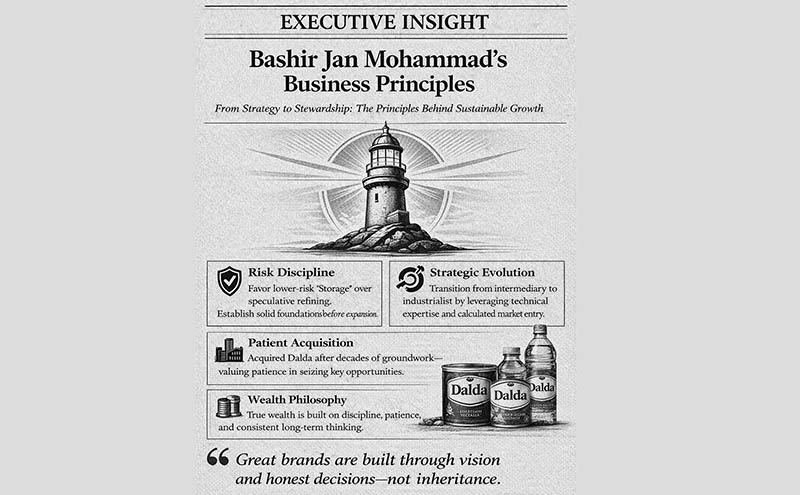
Starting as a junior accountant at Burma Oil, he didn’t just process paperwork; he “listened to the heartbeat of the market”. He identified that the real power in the edible oil industry lay in logistics and storage rather than just refining. By the time the opportunity to buy Dalda from Unilever arrived in 2003, he had spent decades preparing for that single moment. In 2004, he completed a landmark deal worth over one billion rupees, proving that a “migrant boy” with a vision could own the very brand that defined quality for generations.
5 Golden Business Lessons for Entrepreneurs & Engineers
1. Master the “Unit Economics” Before the Vision
Bashir Jan Mohammad spent years sitting among balance sheets and files. He understood the numbers—supply, demand, and margins—before he ever tried to build a factory.
For Engineers: Efficiency isn’t just about the machine; it’s about the cost-to-output ratio.
For Businessmen: If you don’t understand the “heartbeat” of your ledger, you cannot lead the market.
2. Identify the “Bottleneck” in the Industry
While others focused on the final product (refined oil), Bashir realized the real bottleneck was Storage. He chose to invest in storage capacity (20,000 tons in Karachi by 1980) rather than high-risk refining early on.
The Lesson: Control the part of the supply chain that others ignore. Whoever controls the storage controls the timing of the sale.
3. Relationships are the Ultimate “Joint Venture”
His partnership with Malaysia (MAPAK) and his meeting with leaders like Mahathir Mohamad started with a “simple dinner table conversation”. He prioritized trust and loyalty (paying royalties on time and maintaining standards) over short-term tricks.
The Lesson: In the Middle East and South Asia, business moves at the speed of trust. A single honest relationship can build a kingdom.
4. Avoid “Emotional” Debt
Despite low interest rates offered by banks, he largely avoided heavy debt, preferring sustainable and “low-risk” steady steps.
The Lesson: Scalability is dangerous if it is built on a mountain of high-interest loans. Build with your own strength so you don’t collapse during a market “storm”.
5. Solutions Over Complaints (The “Hal” Mindset)
The article title highlights a core philosophy: Value the solution (Hal) rather than the complaint (Shikwa). When the 1971 nationalization policy shook industry leaders, he didn’t quit; he shifted his strategy to become a “middle man” and rebuilt from there.
The Lesson: A crisis is just a change in the rules of the game. Don’t complain about the rules—learn to play better under them.
“Big brands are not born from inheritance; they are built from vision, wisdom, and a simple table where honest conversations happen.”