
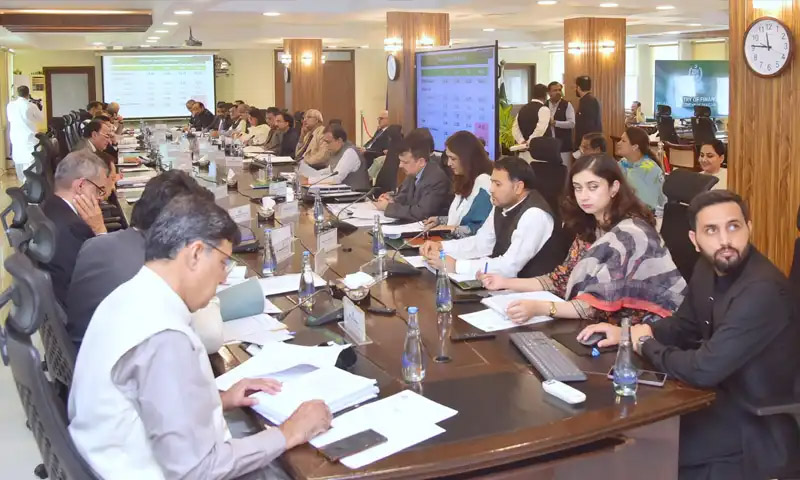
In a significant push towards industrial revitalization and economic reform, the Economic Coordination Committee (ECC) of the Cabinet approved multiple key initiatives, including the revival plan for the steel sector, green financing frameworks, skill development bonds, and affordable housing support schemes.
Chaired by Finance Minister Senator Muhammad Aurangzeb, the ECC endorsed the Ministry of Commerce’s comprehensive report aimed at strengthening the steel industry through reduced production costs and bolstered export competitiveness under the National Tariff Policy 2025–30. The steel sector, which produced 8.4 million metric tons in FY24—60% of which were long products—lags globally in per capita steel usage at just 36kg compared to the world average of 247kg.
The ECC also greenlit a mark-up subsidy and a risk-sharing scheme to promote affordable housing finance. To improve policy targeting and execution, the committee urged the development of an integrated national housing database in coordination with federal and provincial entities.
On legal matters, the ECC approved an appeal to the Supreme Court against a Lahore High Court decision that granted gas/RLNG tariff concessions to M/s Ghani Glass Ltd. The move comes after withdrawal of such concessionary tariffs from all export sectors.
In a landmark environmental decision, Pakistan’s first-ever Green Taxonomy was approved, setting the stage for structured green financing. The chair hailed it as a crucial and overdue step toward sustainable development.
For skill development, Rs1 billion government guarantee was sanctioned to back the Pakistan Skill Impact Bond (PSIB), an outcome-based financing initiative. The ECC encouraged transitioning to public-private partnerships to reduce dependency on state guarantees.
In the energy sector, concerns were raised about limited domestic pass-through of declining international oil prices. The Ministry of Industries was advised to intensify oversight in coordination with the Competition Commission and provincial bodies.
Reforms in telecom included the revision of charges for Radio-Based Services (RBS), with the ECC mandating periodic reviews in alignment with economic and technological shifts. Additionally, the composition of the advisory committee for IMT spectrum release was revised to support 5G readiness.
The ECC also formally declared ship breaking and recycling a recognized industry, with further analysis required to transition it to industrial power tariffs.