
A candid conversation with Engr. Rakhshan Ali Khan
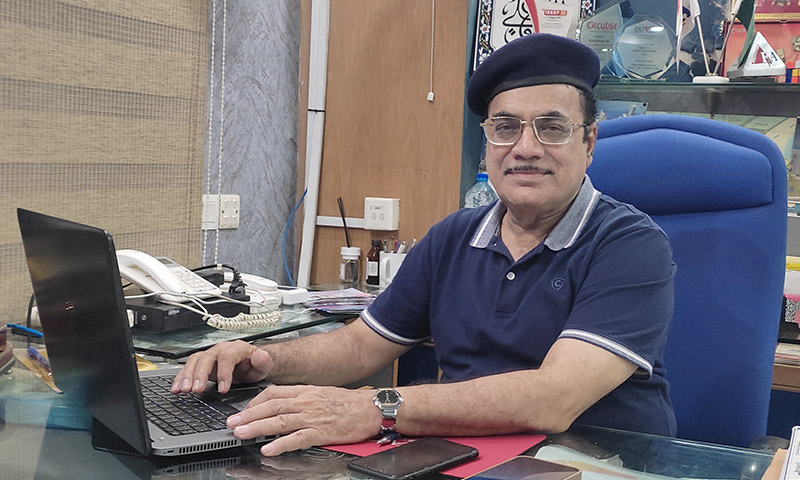
Rakhshan Ali Khan, a luminary in the field of electrical engineering consultancy, has built a remarkable career defined by innovation, quality, and a commitment to bridging the gap between design and practical implementation. As the founder of Advance Engineering Associates and A.E.A International (Pvt.) Ltd, Rakhshan Ali Khan has played a pivotal role in shaping Pakistan’s MEP (Mechanical, Electrical, and Plumbing) and Renewable consultancy landscape. In a detailed conversation exclusively with Engineering Post, Rakhshan Ali Khan offered insights into his journey, the state of the industry, and his vision for the future.
Reflecting on the origins of his company, Rakhshan Ali Khan shared, “I began my professional journey in the field of Electrical engineering by receiving hands-on training from Wali Jan Associates. With a strong foundation in practical consultancy work, I went on to establish my own firm, Advance Engineering Associates, in 1997”, he recalled. Explaining the choice of name, he said, “I named the company Advance because no matter what new innovations come, I always strive to introduce the advance technologies and bring them to the market.” The firm initially focused on delivering high-quality MEP solutions across Pakistan, but its reputation for excellence soon led to international projects in the UK and UAE, including notable developments in Dubai and Sharjah. Recognizing the global demand for standardized engineering practices, Rakhshan Ali Khan founded A.E.A International (Pvt.) Ltd in 2019. “I was driven by a passion to bridge the gap between design integrity and practical MEP implementation,” he explained, emphasizing his commitment to delivering integrated, code-compliant solutions worldwide.
Today, A.E.A International stands as one of Pakistan’s leading MEP consultancy firms, with a diverse portfolio spanning commercial towers, hospitals, and industrial facilities. Rakhshan Ali Khan proudly noted, “Our company today stands strong in both scale and reputation, having successfully delivered several major projects across key sectors.” Notable projects include work for M/s. Artistic Group of Companies, M/s. Soorty Enterprises (Pvt.) Ltd, and M/s. Continental Biscuits Limited in Pakistan, as well as high-profile developments in the UAE, such as a G+6P+H.C. + 46RES. + DUPLEX building and a proposed building with a helipad in Sharjah. “Thanks to the adoption of AI technologies, we are now able to deliver projects within just 3-4 weeks, significantly improving efficiency,” Rakhshan Ali Khan remarked.
When asked about team selection, Rakhshan Ali Khan emphasized a rigorous process. “We hire fresh Engineers from top-tier universities and train them from the ground up to shape them into capable professionals,” he said. For Rakhshan Ali Khan, a good engineer or consultant must possess not only technical expertise but also foresight and problem-solving skills. “A good engineer or consultant must not only design but also foresee site-level challenges and offer value-engineered solutions,” he added.
Discussing the role of electrical consultants in Pakistan, Rakhshan Ali Khan observed that the industry is evolving, with senior consultants prioritizing our quality and long-term solutions. However, he expressed concern about newer entrants prioritizing profits over service quality. “The role of electrical consultants in Pakistan is evolving, senior consultants generally play a positive role, focusing on quality engineering and long-term solutions. However, few newer entrants tend to prioritize earnings over service quality,” he noted. He believes the most critical responsibility of a consultant is comprehensive project oversight. “In my opinion, the most critical responsibility of an MEP consultant is not just to provide design drawings, but to ensure end-to-end supervision and proper implementation of the design, from concept to execution so that the project meets safety, efficiency, and quality standards,” Rakhshan Ali Khan stated.
A significant challenge, according to Rakhshan Ali Khan, is the disconnect between client expectations and consultancy services. “Clients often expect fast-track designs without fully understanding the depth and coordination required,” he said, highlighting the misconception that consultancy is merely documentation rather than strategic problem-solving. To address this, he advocates for better integration through tools like Artificial Intelligence (AI) and Building Information Modeling (BIM). “Better integration through tools like AI, BIM, early-stage consultant engagement enhance coordination between engineering and consultancy. It streamlines communication, reduces human error, and accelerates project timelines,” he explained.
Rakhshan Ali Khan believes that MEP consultancy is not given the importance it deserves in Pakistan. “It’s frequently treated as a secondary requirement. Many projects suffer due to late involvement or lack of respect for detailed engineering input,” he said. He also highlighted the limited legal and government support for consultants, noting that government bodies focus more on registration fees than providing technical or financial assistance. “There’s a strong need for the government to actively support, train, and monitor new engineers to help raise professional standards across the industry,” Rakhshan Ali Khan urged.
On the topic of local products, Rakhshan Ali Khan expressed confidence in Pakistan’s manufacturing capabilities. “I confidently support and promote locally manufactured electrical products provided they meet the exact specifications and quality standards of international benchmarks,” he said. He encourages consultants to act as quality gatekeepers by specifying higher standards, providing manufacturer feedback, and promoting third-party testing. When choosing between local and imported products, Rakhshan Ali Khan considers factors such as reliability, compliance with international standards, after-sales support, cost-effectiveness, and spare availability.
The gap between engineering education and real-world application is a significant concern for Rakhshan Ali Khan. “Engineers are often well-versed in theory but lack exposure to real systems, project workflows, codes, and practical problem-solving,” he said, pointing to minimal industry-academia collaboration as a key issue. To young engineers, he recommends focusing on growth areas like artificial intelligence, renewable energy, building automation, energy auditing, industrial control systems, and smart infrastructure. “My personal message to aspiring consultants is: Invest time in learning, work hard, and take full ownership by supervising projects from start to finish to ensure quality and success,” Rakhshan Ali Khan advised.
Reflecting on his career, Rakhshan Ali Khan shared a valuable lesson learned from a common industry challenge. “One important lesson I learned is that even when I work in advance and present detailed designs, clients sometimes still bypass consultants and award jobs directly to contractors. This taught me the importance of establishing clear agreements early on,” he said. Despite such challenges, he remains optimistic about the future of electrical engineering in Pakistan. “With increasing demand for infrastructure, energy management, and smart systems, electrical engineering will remain a high-demand and impactful field,” Rakhshan Ali Khan affirmed.
Rakhshan Ali Khan believes that no consultancy area is inherently high-risk if designs are thorough. “I believe no area in consultancy is truly high-risk if the design is thorough and well-prepared; a proper design ensures smooth and successful project execution regardless of complexity,” he said. To elevate Pakistan’s electrical sector to international standards, he suggests enforcing building codes, mandating continuous professional development, supporting local R&D, incentivizing quality manufacturing, and promoting digital engineering practices like BIM and international software tools.
Rakhshan Ali Khan’s journey reflects a steadfast commitment to excellence and innovation. His insights highlight the challenges and opportunities Forms: opportunities within Pakistan’s electrical engineering sector, offering a roadmap for aspiring consultants and a vision for a globally competitive industry. Through his leadership, Rakhshan Ali Khan continues to drive progress, ensuring that engineering solutions meet the highest standards of safety, efficiency, and quality.